Monday, October 17, 2011
Our blog has moved!
Please visit http://vetswithoutborders.ca/blog/lao-pdr/ for our updated blog of the Vets without Borders Laos page


Vaccination day in Paksapmai


The first day of rabies vaccination in the Laos VEVEP Rabies Campaign was busy and productive. Eight students from the Veterinary (paravet) Program at the National University of Laos accompanied four faculty and VWB veterinarian Anne Drew, to Ban Paksapmei. The three PAHWs – Primary Animal Health Workers – of the village met us at a corner store where a few villagers already waited with their dogs. Quickly stools and a table were set up to provide four stations. The first held the vaccination materials: muzzles and rope leashes, cooler with vaccine, needles and syringes, disposal containers for sharps and trash, and coloured neck markers for the vaccinated dogs. Then owners moved down a row providing recording and certificates, a short questionnaire on dog demographics and rabies awareness, and an information station where they received pamphlets in Lao and oral instruction. Emphasis was placed on what to do in the event of a dog bite and/or suspected rabies exposure: Wash the wound! Seek medical attention. Inform the authorities.
Lao dogs are rarely confined or leashed, but we had decided to require dogs be brought to a central location, rather than travelling house to house. This was due to time constraint – one day per village – and our feeling that given free vaccination, villagers could make the effort. Some misgiving as to whether many would show up was quickly dispelled with the first rush between 8:30 and 10. Dogs came following their owners freely or carried in arms. Litters of puppies arrived with families of young children carrying one apiece. Some dogs walked, reluctantly, on ropes and chains. A number arrived by motorcycle – either in the basket carrier (loose!), or carried by a passenger. One lady even drove with her fully-grown dog clamped between her knees. The occasional upscale family brought dogs by car, and one gentleman had a wire cage on a traditional wooden handcart.
Dogs were vaccinated by a PAHW, under Faculty supervision, while students manned the remaining stations, and I circulated as troubleshooter. Although the vaccine is labeled for dogs over three months, in a rabies-control vaccination campaign it is recommended to vaccinate all dogs; research in Tanzania has shown that young pups mount a strong immune response. I’m personally less comfortable vaccinating under 4 weeks, so we chose this age as cutoff in our public announcements, but vaccinated any presented.
An occasional dog escaped when attempts were made to muzzle it, and the team is learning to make sure panicky dogs are well secured before proceeding. Lao dogs, though unused to restraint, are well treated and generally good tempered, and no one was injured. The team shared a lunch of chicken soup, papaya salad and rice, before proceeding to the afternoon location. In all, 148 dogs and 6 cats were vaccinated. The Campaign will cover the remaining 10 project villages over the next 11 days, with a two day break for the Lao Boat Racing Festival, also the end of the three month Rains Retreat for Buddhist monks.
By Anne Drew


Friday, September 9, 2011
Preparing for World Rabies Day


This year Vets without Borders is launching a new rabies campaign in Laos. Many people and agencies who work with rabies recognise that despite being a fatal disease, it is often neglected by funding agencies and health programs. Yet the ASEAN (Association of Southeast Asian Nations) Call for Action to eliminate rabies by 2020 is a promising backdrop. Rabies prevention is complex and is a perfect example of a 'One Health' problem which can be best addressed using 'Ecohealth' approaches.
Rabies is endemic in Laos and although there is no up to date surveillance data, a 2002 study in Vientiane showed that only 48% of sampled dogs had been vaccinated against rabies: recommended coverage to eliminate rabies from a population is at least 70%.
This October, the Laos VEVEP project, through the National University of Laos, will mobilise our 33 Primary Animal Health Workers to vaccinate dogs in their villages and reach maximum coverage. Dog vaccination is shown to be the cheapest and most effective way to prevent rabies. Its impact is even greater when combined with public education, responsible dog ownership, dog population management and access to human vaccine for bite victims. Long-term vet volunteer Anne Drew will be leading the team in October to help fight rabies in Laos, and cooperating with other agencies in the country. Let's make rabies history!
Saturday, August 20, 2011
Livelihoods: poultry for income generation


(Photos by Anne Drew)
This summer the Laos VEVEP team, in response to farmers' requests, added a new livelihoods focus to the project in Laos. In addition to our regular support of Primary Animal Health Workers (PAHWs), we have now worked closely with 42 families in 3 villages to provide training in poultry management, and distributed chicks as the start of a 'pass on' scheme. The project supports mix-breeds and aims to allow farmers to grow healthier and more productive chickens, thus gaining income from increased sales, as well as increased access to chicken meat as and when needed. Farmers have been keen to start good habits like vaccinating their chickens more regularly and ensuring good quality housing and feed. Through the ongoing support of the PAHWs we are developing a new project model to branch out to other villages next year.
Sunday, June 12, 2011
Hellos and Goodbyes
This is an exciting time for VWB/VSF in Lao PDR. We have formed two new partnerships in Savannakhet Province. Savannakhet University (SKU) and the Eco Guide Unit (EGU) are hosting our first Student Volunteer Placements in Laos. Four veterinary students from the Atlantic Veterinary College, Prince Edward Island, Western College of Veterinary Medicine, Saskatchewan and Faculté de Médecine Vétérinaire, Quebec are volunteering in Lao PDR for three months.

One project, in association with a PhD researcher in primate conservation, hopes to establish the presence of Silvered Leaf Monkeys (Trachypithecus germaini) in the Dong Phouvieng National Protected Area. The species is classified as globally endangered and the project will explore the related conservation and ecotourism implications of such findings.
Two other volunteers based at SKU will be helping to develop curriculum materials for a Bachelor degree program in Animal Science. With the majority of Lao people depending on subsistence agriculture, programs such as this help to build much needed capacity. These volunteers will also be helping with vaccination programmes and teaching English.

Sadly, we have recently said goodbye to Dr Anne Drew and her husband Thom who have just completed their second volunteer mission with the Village Ecohealth and Veterinary Extension Project in Xaythany District, Vientiane province, and their contributions have been invaluable. The couple has become part of the Nabong community and their absence is already being felt. A huge thank you to them for all of their hard work and dedication.
Part of Anne and Thom’s work included setting the groundwork for a poultry project and establishment of rural veterinary drug vendors. Updates on these activities to follow soon…


One project, in association with a PhD researcher in primate conservation, hopes to establish the presence of Silvered Leaf Monkeys (Trachypithecus germaini) in the Dong Phouvieng National Protected Area. The species is classified as globally endangered and the project will explore the related conservation and ecotourism implications of such findings.
Two other volunteers based at SKU will be helping to develop curriculum materials for a Bachelor degree program in Animal Science. With the majority of Lao people depending on subsistence agriculture, programs such as this help to build much needed capacity. These volunteers will also be helping with vaccination programmes and teaching English.

Sadly, we have recently said goodbye to Dr Anne Drew and her husband Thom who have just completed their second volunteer mission with the Village Ecohealth and Veterinary Extension Project in Xaythany District, Vientiane province, and their contributions have been invaluable. The couple has become part of the Nabong community and their absence is already being felt. A huge thank you to them for all of their hard work and dedication.
Part of Anne and Thom’s work included setting the groundwork for a poultry project and establishment of rural veterinary drug vendors. Updates on these activities to follow soon…

Friday, April 15, 2011
Learning in action with Aeroplan


(Photos L-R by Amanda Sital, Sheila Taylor, Anne Drew)
Capacity building is not only crucial for building skills and knowledge in hard-to-reach areas, but a vital aspect of global cooperation and learning. As part of Vets without Borders' Beyond Miles program, our project in Laos hosted a team of 4 Aeroplan employees to visit, learn, eat and sleep the Lao way.
Villagers in Thachampa graciously hosted a delicious lunch for the visitors, and we met PAHWs and participants from last year's Community Health Days to share their thoughts about what the project is doing for them and where they want to see it go next. The 'delegation', which included Anne and Thom, other VWB/VSF colleagues and guests, also visited the beautiful area of Dong Sakee Sacred Forest in Savannakhet province, southern Laos, as part of a reconnaissance journey for our upcoming student placement this summer. Overall we've learnt a lot more about the farmers with whom we work and experienced the wonderful generosity and welcome of our partner communities.
Thanks to the Aeroplan miles which our friends and members donate we are able to send vets like Anne Drew and our student volunteers to work with these communities in need. Can you help us by donating your air miles? Click here to find out more:
http://www1.aeroplan.com/use_your_miles/donate_miles/charity.do?donationAE=922056320
Saturday, March 5, 2011
mentoring news


Nearly two months into our stay at NUOL, our support and training work with the PAHWs (Primary Animal Health Workers) has taken shape well. The PAHWs are providing lots of interesting exchanges and useful feedback.
A village mentoring visit with the PAHWs is set up by one of the Animal Health lecturers at the University, who also provide some ambulatory services to the villages. A morning visit means we can ask the visit host – one of the PAHWs – to hold back his animals from grazing for us to do some practical work. Each village started with 3 PAHWs trained, but attrition and their other responsibilities means we usually have 2 present, occasionally 3.
Our team consists of me and Thom, Lampheuy – our coordinator and translator, an Animal Nutrition specialist, lecturer and PhD student – and one of the Animal Health lecturers, often Sisawat. Sitting outdoors with the group, I check record books and ask about cases they have seen, which leads us into case discussions. We review clinical signs, probable diagnoses, treatments and outcomes. The PAHWs are questioned about what specific support they need from the team. We then move on to practical work, using what ever animal is available to practice restraint and handling, physical exam and evaluation. I’ve introduced deworming of dogs, and we have also been discussing and sometimes applying flea treatment. Before leaving we have distributed 10m. ropes suitable for casting cows, and large gauge needles which may sometimes be useful in relieving bloat – an oft-cited killer of cows in the rainy season.
At some visits we have a sick animal to work with, always an excellent learning opportunity. This week in Douneane village we saw a cow 1 month fresh with a lame leg, which one PAHW had treated the 2 previous days. We were able to review case reporting (presenting signs, history, findings, treatment and rationale), restrain and examine her, discuss the probable diagnosis and the indicated treatments, estimate the weight of the cow, calculate drug dosages, and have each PAHW draw and administer one injection. We covered nursing care, ie the need for provision of water to an animal with restricted mobility, the effect on milk production and the well-being of the calf of withholding water. Our conclusions were that she had a normal temperature, thin body condition, and a hock injury which was improving. I also took a fecal sample to do a float back at the lab.
Yesterday in the lab I floated the sample in saturated sugar solution and demonstrated a moderately heavy load of GIN eggs (validating our deworming treatment of the previous day). I was working alone with this first sample to investigate what equipment was available, the condition of microscopes, etc., but on my way out of the lab I saw Sisawat and asked if he would like to see the slide. Sisawat and a vet student, Souksawat came with me, and we collected another veterinary program lecturer, Sitisai, along the way. Once she saw us in the lab, the lab supervisor also came in and took a look. When I left, Sitisai was taking a picture of the slide. This very simple technique should be readily transferable to the teaching program and provide a good rationale for treatment programs in the villages.

Thursday, February 3, 2011
Wednesday, February 2, 2011
Mentoring in full swing
With the dry season now in full swing, Veterinarian Anne Drew is again working with Primary Animal Health workers (PAHWs) to improve animal healthcare in Xaythany District. After playing a key role in a vaccination campaign against Haemorrhagic septicaemia (HS) at the end of last year, encouraging more farmers than before to vaccinate their cattle, the PAHWs are more motivated than ever to continue providing healthcare serivces. However, they still need a lot of training and support to learn about better disease prevention, treatment and livestock management.
Here Anne and Lampheuy discuss bloat treatments for cattle with the PAHWs in Senoudom village.

Here Anne and Lampheuy discuss bloat treatments for cattle with the PAHWs in Senoudom village.

Thursday, September 30, 2010
MoU Celebration

VWB/VSF and the Faculty of Agriculture, National University of Laos (NUOL) were happy to celebrate the signing of an MoU (Memorandum of Understanding) between the two institutions this September. This agreement recognises our mutual interest and commitment in working together over the coming years and is a key step in developing our activities to bring further benefits to the wider communities involved. Other key partners in the project include the District Agriculture and Forestry Office, the Health Department and local farmers and the Women’s Union.


Tuesday, September 21, 2010
Community spirit for health

This month saw the launch of our first Community Health Day, which will take place in 10 more villages. These events aim to promote the services of PAHW volunteers by introducing them to their community, are an occasion for children and adults to learn about community health and hygiene whilst having fun, and are also raising awareness about this year’s national cattle vaccination campaign on 11 November (focused on haemorrhagic septicaemia). The organisers are also excited about preparing dances, songs and traditional games.
The Community Health Day in Sen Oudom village was held on 14th September. Introductory speeches were given by Dr Sompanh, the Faculty of Agriculture Vice-dean, the Village Chief, and by the 3 PAHWs. It provided an opportunity to introduce the PAHWs to their neighbours and increase the community’s understanding of their role in disease prevention and animal treatment.
The District Department of Health, as well as the Water and Environment Resources Office, both provided entertaining and informative sessions including games and talks on waste management, pollution, household hygiene, bio-security, as well as tips for preventing dengue fever, currently rife in the area. The day ended with fun and engaging health videos which both children and parents enjoyed. More Community Health Days are planned throughout September and October, making these a couple of busy but exciting months for the project team in the lead up to the harvesting season and annual dragon boat festival.


Wednesday, August 25, 2010
Refresher training and worms in a chicken


Post-mortems, vaccination and disease prevention were order of the day at this month’s Refresher Training. After mentoring visits over the summer, the Refresher Training for Primary Animal Heatlh Workers (PAHWs) was an opportunity to bring everyone together to share their experiences so far.
The workshop used learner-centred methods to ensure participants were actively involved and felt responsible for their own learning. Small group discussions were held on most topics, while games were injected throughout to maintain energy levels and review learning. We also did focus group discussions to assess the effectiveness of posters on disease diagnosis and treatment. The highlight of the workshop was by all accounts the post mortem exam led by NUOL and DAFO staff. The group discovered that compared to ducks, the chickens examined had a high proportion of intestinal parasites, including ascaris, tapeworm and cecal worm. This was an eye-opener about the importance of de-worming, and reflects the scavenging behaviours of local chickens.
At the end of each day of the workshop, the PAHWs gave feedback on the day and mentors deliberated on how to adapt the agenda. The mood barometer showed increasingly positive results with most of the PAHWs happy about their continued learning. The workshop also served as a launch pad for the upcoming Community Health Days, which we will recount in September!


Sunday, August 8, 2010
Training of Trainers
 Left-to-right: Sonia, Malavanh, Taffese, Daovy, Blanaid
This week we completed the Training of Trainers in preparation for our second PAHW training workshop. The Ecohealth team met with colleagues from the District Agriculture and Forestry Office, the University’s Faculty of Agriculture, and Environment, as well as the District health clinic, some of whom have been training and mentoring the PAHWs over the past six months.
 Kolakoth and Daovy playing the balloon game
The objective of this 3-day workshop was to strengthen the mentors’ capacity in participatory learning techniques, to develop the content for the PAHW training and to brainstorm ideas for the Community Health Days that are being planned for this autumn. Participatory learning is particularly important in this context where the purpose of the work is to improve villagers’ practical skills. It also recognizes that the learners already possess a great deal of knowledge and allows them to exchange this information with the trainers and each other. The training emphasized how important it is for discussions and presentations to be interactive, and for participants to have fun! Everybody got their heart beat racing while playing the balloon game on the first day. As well as being a chance to play and laugh together, this was a lesson in cooperation and communication skills.
 Chicken post mortem
Left-to-right: Tongtem (DAFO), Keo (DAFO), Taffese (VSF), Dehtaloon (NUOL)
The trainers also learned some new practical skills through Taffese’s laboratory session on “How to do a post mortem examination”. The trainers were very interested to enhance their diagnostic skills and are eager to pass this knowledge onto the PAHWs.
Tuesday, July 6, 2010
Loving (work-)life in Laos
 The centre of Nabong Campus
Now that the field interviews are wrapping up, the team here at Nabong is moving into a planning phase and things are much quieter than during my last update. Taffese and I are preparing the next training workshop for the Primary Animal Health Workers (PAHWs). This will involve refreshing some of the information from the initial training in February and building on this through hands-on practical sessions and interactive discussions.
Over the past few days Taffese has been called out to the field to see a number of disease cases. From goats with wound infections to diarrhea in piglets he’s been providing assistance to the PAHWs. One particularly interesting case was an adult bull whose owner noticed the tongue hanging out and he seemed to be unable to eat. When Taffese went to see it there was pus-like green discharge coming from the mouth and his neck was swollen. He appeared thin and dehydrated from being off feed. While they were unable to get a good look inside, Taffese suspected that there was some sort of foreign body caught in the mouth or throat that was causing infection. He recommended that the bull be put down for humane reasons. Hopefully we will be conducting a post-mortem exam to fully understand the disease process.
Over the past few days Taffese has been called out to the field to see a number of disease cases. From goats with wound infections to diarrhea in piglets he’s been providing assistance to the PAHWs. One particularly interesting case was an adult bull whose owner noticed the tongue hanging out and he seemed to be unable to eat. When Taffese went to see it there was pus-like green discharge coming from the mouth and his neck was swollen. He appeared thin and dehydrated from being off feed. While they were unable to get a good look inside, Taffese suspected that there was some sort of foreign body caught in the mouth or throat that was causing infection. He recommended that the bull be put down for humane reasons. Hopefully we will be conducting a post-mortem exam to fully understand the disease process.

Taffese's patient
While Taffese is out getting his hands dirty, I’ve been in the office creating some educational materials that the PAHWs can use during training and as a reference for their practice. It’s really important that we provide tools that will help them to continue learning long after we’re gone. Not quite as glamourous as wrestling buffalo like Taffese but rewarding all the same!
The most striking thing about my experience here is that despite the more laid-back lifestyle in Laos, time is really flying by! I’m almost halfway through my practicum and it still feels like I’ve just landed. I have to admit that I was nervous about being away for 3 months but this is such a beautiful country filled with beautiful people that I think it will be difficult to make the transition back to grad student life in Guelph.

Our home on campus
Tuesday, June 15, 2010
A new crush. Wait...not that kind of crush!
My first week at the Faculty of Agriculture at the Nabong Campus of the National University of Laos (NUOL) was spent out in the field with the Primary Animal Health Workers (PAHWs) and community members.
Taffese, the veterinarian volunteer from Ethiopia and Lampheuy, one of our project coordinators from NUOL, began interviewing the PAHWs about their experiences and progress since their training in February. They also held community meetings for the first 4 villages to discuss the project as well as their needs for education on animal health and production.

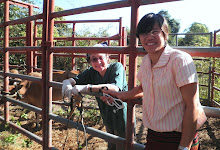
Another exciting activity of the week was the building of a crush in Paksapmai village on Sunday. Safe animal handling has been an issue for most of the PAHWs and it was recommended that all livestock owners build crushes. Under Taffese’s guidance some of the teachers from the university, the chief of the village and the PAHW herself, Miss Saiponh collected the materials. On one of the hottest days since we arrived, in a matter of about 4 hours, the crush was complete!

Taffese, the veterinarian volunteer from Ethiopia and Lampheuy, one of our project coordinators from NUOL, began interviewing the PAHWs about their experiences and progress since their training in February. They also held community meetings for the first 4 villages to discuss the project as well as their needs for education on animal health and production.
Our discussions with the first 12 PAHWs were very rewarding. We gained great insight as to their feelings about the project, where we have been successful and where we can direct our future efforts. We learned that they are very comfortable with many technical skills such as administering injections. They also brought some of their challenges to our attention, the most common challenge being that the nearest pharmacy is in Vientiane which is about an hour’s drive away. We were pleased to learn that the PAHWs are communicating with each other quite frequently, sharing experiences and helping with treatments.


The community members feel that when they asked for the PAHWs’ support, they were very helpful and often responded to their calls very quickly despite their other commitments (the PAHWs are volunteers and most of them are also farmers, only working part-time at this job). We heard that the community is unsure about vaccination and would like to learn more about preventing various diseases as well as improving their animal management practices.
The community members feel that when they asked for the PAHWs’ support, they were very helpful and often responded to their calls very quickly despite their other commitments (the PAHWs are volunteers and most of them are also farmers, only working part-time at this job). We heard that the community is unsure about vaccination and would like to learn more about preventing various diseases as well as improving their animal management practices.
We will be using this information to create training and information sessions for the PAHWs and the communities.

Another exciting activity of the week was the building of a crush in Paksapmai village on Sunday. Safe animal handling has been an issue for most of the PAHWs and it was recommended that all livestock owners build crushes. Under Taffese’s guidance some of the teachers from the university, the chief of the village and the PAHW herself, Miss Saiponh collected the materials. On one of the hottest days since we arrived, in a matter of about 4 hours, the crush was complete!
As for my own experiences in Laos, I was thrilled to find that I feel very much at home here and I believe that this is due to the overwhelming warmth and hospitality extended to Taffesse and myself both by our colleagues at the Faculty of Agriculture and the community members.
Wednesday, February 24, 2010


Subscribe to:
Posts (Atom)