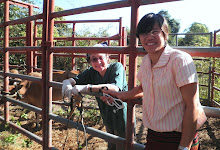
Taffese, the veterinarian volunteer from Ethiopia and Lampheuy, one of our project coordinators from NUOL, began interviewing the PAHWs about their experiences and progress since their training in February. They also held community meetings for the first 4 villages to discuss the project as well as their needs for education on animal health and production.
Our discussions with the first 12 PAHWs were very rewarding. We gained great insight as to their feelings about the project, where we have been successful and where we can direct our future efforts. We learned that they are very comfortable with many technical skills such as administering injections. They also brought some of their challenges to our attention, the most common challenge being that the nearest pharmacy is in Vientiane which is about an hour’s drive away. We were pleased to learn that the PAHWs are communicating with each other quite frequently, sharing experiences and helping with treatments.


The community members feel that when they asked for the PAHWs’ support, they were very helpful and often responded to their calls very quickly despite their other commitments (the PAHWs are volunteers and most of them are also farmers, only working part-time at this job). We heard that the community is unsure about vaccination and would like to learn more about preventing various diseases as well as improving their animal management practices.
The community members feel that when they asked for the PAHWs’ support, they were very helpful and often responded to their calls very quickly despite their other commitments (the PAHWs are volunteers and most of them are also farmers, only working part-time at this job). We heard that the community is unsure about vaccination and would like to learn more about preventing various diseases as well as improving their animal management practices.
We will be using this information to create training and information sessions for the PAHWs and the communities.

Another exciting activity of the week was the building of a crush in Paksapmai village on Sunday. Safe animal handling has been an issue for most of the PAHWs and it was recommended that all livestock owners build crushes. Under Taffese’s guidance some of the teachers from the university, the chief of the village and the PAHW herself, Miss Saiponh collected the materials. On one of the hottest days since we arrived, in a matter of about 4 hours, the crush was complete!


As for my own experiences in Laos, I was thrilled to find that I feel very much at home here and I believe that this is due to the overwhelming warmth and hospitality extended to Taffesse and myself both by our colleagues at the Faculty of Agriculture and the community members.