Tuesday, July 6, 2010

Loving (work-)life in Laos

The centre of Nabong Campus

Now that the field interviews are wrapping up, the team here at Nabong is moving into a planning phase and things are much quieter than during my last update. Taffese and I are preparing the next training workshop for the Primary Animal Health Workers (PAHWs). This will involve refreshing some of the information from the initial training in February and building on this through hands-on practical sessions and interactive discussions.

Over the past few days Taffese has been called out to the field to see a number of disease cases. From goats with wound infections to diarrhea in piglets he’s been providing assistance to the PAHWs. One particularly interesting case was an adult bull whose owner noticed the tongue hanging out and he seemed to be unable to eat. When Taffese went to see it there was pus-like green discharge coming from the mouth and his neck was swollen. He appeared thin and dehydrated from being off feed. While they were unable to get a good look inside, Taffese suspected that there was some sort of foreign body caught in the mouth or throat that was causing infection. He recommended that the bull be put down for humane reasons. Hopefully we will be conducting a post-mortem exam to fully understand the disease process.


Taffese's patient

While Taffese is out getting his hands dirty, I’ve been in the office creating some educational materials that the PAHWs can use during training and as a reference for their practice. It’s really important that we provide tools that will help them to continue learning long after we’re gone. Not quite as glamourous as wrestling buffalo like Taffese but rewarding all the same!

The most striking thing about my experience here is that despite the more laid-back lifestyle in Laos, time is really flying by! I’m almost halfway through my practicum and it still feels like I’ve just landed. I have to admit that I was nervous about being away for 3 months but this is such a beautiful country filled with beautiful people that I think it will be difficult to make the transition back to grad student life in Guelph.

Our home on campus

Tuesday, June 15, 2010

A new crush. Wait...not that kind of crush!

My first week at the Faculty of Agriculture at the Nabong Campus of the National University of Laos (NUOL) was spent out in the field with the Primary Animal Health Workers (PAHWs) and community members.

Taffese, the veterinarian volunteer from Ethiopia and Lampheuy, one of our project coordinators from NUOL, began interviewing the PAHWs about their experiences and progress since their training in February. They also held community meetings for the first 4 villages to discuss the project as well as their needs for education on animal health and production.

Our discussions with the first 12 PAHWs were very rewarding. We gained great insight as to their feelings about the project, where we have been successful and where we can direct our future efforts. We learned that they are very comfortable with many technical skills such as administering injections. They also brought some of their challenges to our attention, the most common challenge being that the nearest pharmacy is in Vientiane which is about an hour’s drive away. We were pleased to learn that the PAHWs are communicating with each other quite frequently, sharing experiences and helping with treatments.


The community members feel that when they asked for the PAHWs’ support, they were very helpful and often responded to their calls very quickly despite their other commitments (the PAHWs are volunteers and most of them are also farmers, only working part-time at this job). We heard that the community is unsure about vaccination and would like to learn more about preventing various diseases as well as improving their animal management practices.

We will be using this information to create training and information sessions for the PAHWs and the communities.


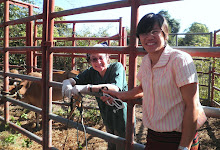
Another exciting activity of the week was the building of a crush in Paksapmai village on Sunday. Safe animal handling has been an issue for most of the PAHWs and it was recommended that all livestock owners build crushes. Under Taffese’s guidance some of the teachers from the university, the chief of the village and the PAHW herself, Miss Saiponh collected the materials. On one of the hottest days since we arrived, in a matter of about 4 hours, the crush was complete!

As for my own experiences in Laos, I was thrilled to find that I feel very much at home here and I believe that this is due to the overwhelming warmth and hospitality extended to Taffesse and myself both by our colleagues at the Faculty of Agriculture and the community members.

Wednesday, February 24, 2010

Images from the PAHW Basic Training Workshop


PAHW training complete


The Basic Training of Primary Animal Health Workers (PAHWs) now complete, the new recruits have set off to practice theirs skills in their communities! Mentors from DAFO and the National University will be supporting the PAHWs in their work, with an initial focus on cattle vaccination.


Tuesday, February 16, 2010

Interviews with farmers

The farmer interviewed here in Palai village provided a good example of how to implement good management practices on limited resources. However others in the village, who had less access to land or other resources, were struggling to make ends meet and replace chickens which had been wiped out from disease last year.


Wednesday, February 10, 2010

Observations

Now that the baseline surveys are complete, initial observations already point to some interesting findings. For example, interviews with farmers indicate low rates of livestock vaccination in most villages, with low awareness of which vaccinations are important. Moreover, whilst some farmers have had their cattle vaccinated in the past year, most do not vaccinate poultry, considering the time and costs involved not to be worth it given the relatively lower value of poultry.

There is a significant need for support amongst low-income households who struggle to invest in livestock and feed. Through improved support for livestock health in these villages, and tailoring of project activities to beneft those in need, we hope to help resolve some of these barriers to income generation and healthy livestock production.


Tuesday, February 2, 2010

Village surveys


This week we are conducting baseline surveys in villages in central Laos.

It has been very informative and we are learning a lot about the different attitudes and opportunities available to farmers.

The wide differences show that there is much room for awareness-raising, income-generating activities and animal health improvements.