Friday, April 15, 2011

Learning in action with Aeroplan


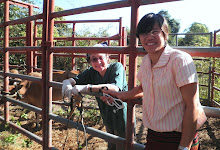
(Photos L-R by Amanda Sital, Sheila Taylor, Anne Drew)


Capacity building is not only crucial for building skills and knowledge in hard-to-reach areas, but a vital aspect of global cooperation and learning. As part of Vets without Borders' Beyond Miles program, our project in Laos hosted a team of 4 Aeroplan employees to visit, learn, eat and sleep the Lao way.

Villagers in Thachampa graciously hosted a delicious lunch for the visitors, and we met PAHWs and participants from last year's Community Health Days to share their thoughts about what the project is doing for them and where they want to see it go next. The 'delegation', which included Anne and Thom, other VWB/VSF colleagues and guests, also visited the beautiful area of Dong Sakee Sacred Forest in Savannakhet province, southern Laos, as part of a reconnaissance journey for our upcoming student placement this summer. Overall we've learnt a lot more about the farmers with whom we work and experienced the wonderful generosity and welcome of our partner communities.

Thanks to the Aeroplan miles which our friends and members donate we are able to send vets like Anne Drew and our student volunteers to work with these communities in need. Can you help us by donating your air miles? Click here to find out more:
http://www1.aeroplan.com/use_your_miles/donate_miles/charity.do?donationAE=922056320

Saturday, March 5, 2011

mentoring news


Nearly two months into our stay at NUOL, our support and training work with the PAHWs (Primary Animal Health Workers) has taken shape well. The PAHWs are providing lots of interesting exchanges and useful feedback.

A village mentoring visit with the PAHWs is set up by one of the Animal Health lecturers at the University, who also provide some ambulatory services to the villages. A morning visit means we can ask the visit host – one of the PAHWs – to hold back his animals from grazing for us to do some practical work. Each village started with 3 PAHWs trained, but attrition and their other responsibilities means we usually have 2 present, occasionally 3.

Our team consists of me and Thom, Lampheuy – our coordinator and translator, an Animal Nutrition specialist, lecturer and PhD student – and one of the Animal Health lecturers, often Sisawat. Sitting outdoors with the group, I check record books and ask about cases they have seen, which leads us into case discussions. We review clinical signs, probable diagnoses, treatments and outcomes. The PAHWs are questioned about what specific support they need from the team. We then move on to practical work, using what ever animal is available to practice restraint and handling, physical exam and evaluation. I’ve introduced deworming of dogs, and we have also been discussing and sometimes applying flea treatment. Before leaving we have distributed 10m. ropes suitable for casting cows, and large gauge needles which may sometimes be useful in relieving bloat – an oft-cited killer of cows in the rainy season.

At some visits we have a sick animal to work with, always an excellent learning opportunity. This week in Douneane village we saw a cow 1 month fresh with a lame leg, which one PAHW had treated the 2 previous days. We were able to review case reporting (presenting signs, history, findings, treatment and rationale), restrain and examine her, discuss the probable diagnosis and the indicated treatments, estimate the weight of the cow, calculate drug dosages, and have each PAHW draw and administer one injection. We covered nursing care, ie the need for provision of water to an animal with restricted mobility, the effect on milk production and the well-being of the calf of withholding water. Our conclusions were that she had a normal temperature, thin body condition, and a hock injury which was improving. I also took a fecal sample to do a float back at the lab.

Yesterday in the lab I floated the sample in saturated sugar solution and demonstrated a moderately heavy load of GIN eggs (validating our deworming treatment of the previous day). I was working alone with this first sample to investigate what equipment was available, the condition of microscopes, etc., but on my way out of the lab I saw Sisawat and asked if he would like to see the slide. Sisawat and a vet student, Souksawat came with me, and we collected another veterinary program lecturer, Sitisai, along the way. Once she saw us in the lab, the lab supervisor also came in and took a look. When I left, Sitisai was taking a picture of the slide. This very simple technique should be readily transferable to the teaching program and provide a good rationale for treatment programs in the villages.

more mentoring news


Thursday, February 3, 2011

How to examine a goat

PAHWs in Senoudom practise a physical exam with their goat.


Wednesday, February 2, 2011

Mentoring in full swing

With the dry season now in full swing, Veterinarian Anne Drew is again working with Primary Animal Health workers (PAHWs) to improve animal healthcare in Xaythany District. After playing a key role in a vaccination campaign against Haemorrhagic septicaemia (HS) at the end of last year, encouraging more farmers than before to vaccinate their cattle, the PAHWs are more motivated than ever to continue providing healthcare serivces. However, they still need a lot of training and support to learn about better disease prevention, treatment and livestock management.

Here Anne and Lampheuy discuss bloat treatments for cattle with the PAHWs in Senoudom village.


Thursday, September 30, 2010

MoU Celebration


VWB/VSF and the Faculty of Agriculture, National University of Laos (NUOL) were happy to celebrate the signing of an MoU (Memorandum of Understanding) between the two institutions this September. This agreement recognises our mutual interest and commitment in working together over the coming years and is a key step in developing our activities to bring further benefits to the wider communities involved. Other key partners in the project include the District Agriculture and Forestry Office, the Health Department and local farmers and the Women’s Union.


Tuesday, September 21, 2010

Community spirit for health


This month saw the launch of our first Community Health Day, which will take place in 10 more villages. These events aim to promote the services of PAHW volunteers by introducing them to their community, are an occasion for children and adults to learn about community health and hygiene whilst having fun, and are also raising awareness about this year’s national cattle vaccination campaign on 11 November (focused on haemorrhagic septicaemia). The organisers are also excited about preparing dances, songs and traditional games.


The Community Health Day in Sen Oudom village was held on 14th September. Introductory speeches were given by Dr Sompanh, the Faculty of Agriculture Vice-dean, the Village Chief, and by the 3 PAHWs. It provided an opportunity to introduce the PAHWs to their neighbours and increase the community’s understanding of their role in disease prevention and animal treatment.


The District Department of Health, as well as the Water and Environment Resources Office, both provided entertaining and informative sessions including games and talks on waste management, pollution, household hygiene, bio-security, as well as tips for preventing dengue fever, currently rife in the area. The day ended with fun and engaging health videos which both children and parents enjoyed. More Community Health Days are planned throughout September and October, making these a couple of busy but exciting months for the project team in the lead up to the harvesting season and annual dragon boat festival.